
Badreddine Benhellal
Dr. Badreddine Benhellal is a specialist of spectral theory. He is cuurently a lecturer at National Higher School of Mathematics. Contact: badreddine[dot]benhellal[at]nhsm[dot]edu[dot]dz

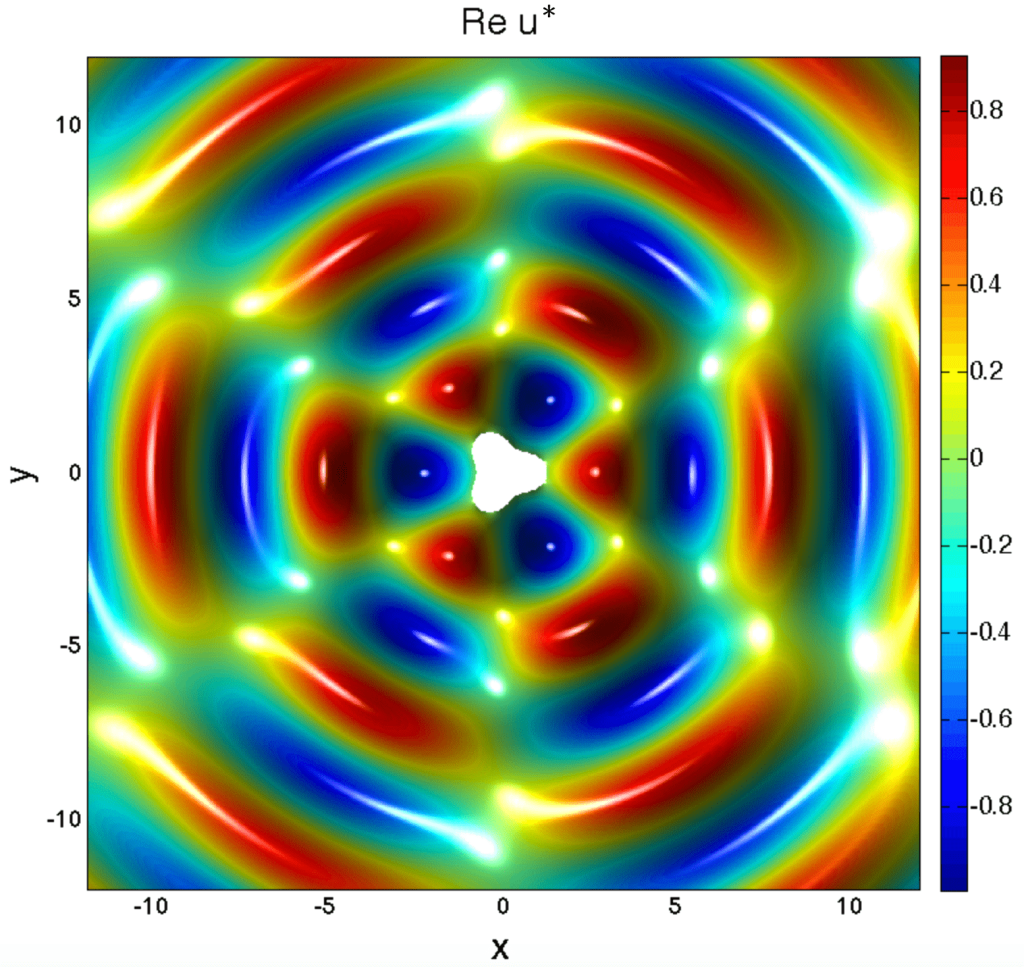
This course is intended for fourth-year students at NHSM (the National Higher School of Mathematics) and aims to introduce them to the basics of the spectral theory of differential operators. This course details chapters for students on unbounded operators, closed operators, symmetric and self-adjoint operators, and the classifications of their spectra and application of the min-max principle, and finally, some aspectes of asymptotics analysis. These chapters will familiarize the student with mathematical formalism in order to develop clear, structured, and rigorous reasoning that can be applied in complex situations.
By the end of this course, students will be able to: Explain why unbounded operators are necessary in differential equations. Explain the difference between symmetric and self-adjoint operators. Explain the role of compact resolvent in obtaining a purely discrete spectrum. Compute the adjoint of simple differential and multiplication operators. Determine whether a given operator is closed, closable, symmetric, or self-adjoint. Construct Weyl sequences to prove that a number belongs to the spectrum. Apply the Friedrichs extension to obtain self-adjoint realizations of semibounded operators. Use the Kato-Rellich theorem to prove self-adjointness of Schrödinger operators. Compare the Dirichlet and Neumann Laplacians on a given domain. Distinguish between discrete and essential spectrum using Weyl criteria. Analyze the stability of the essential spectrum under relatively compact perturbations. Justify the choice of boundary conditions (Dirichlet, Neumann, Robin) for self-adjoint realizations. Evaluate the compactness of resolvents using the Riesz-Kolmogorov criterion. Argue whether a perturbation preserves essential self-adjointness. Formulate a min-max estimate for eigenvalues of a perturbed operator. Propose a domain where the Neumann Laplacian has non-compact resolvent. Develop a Weyl asymptotic argument for Schrödinger operators.
Before starting the course, ensure you have solid understanding of the following topics: Measure theory, Functional analysis (Banach and Hilbert spaces in particular Lp spaces), Fourier transform of squar integrable functions, Theory of bounded (compact) operators. If you didin't follow one of the above courses, then please start by felling your gaps by registering to the messing courses before proceeding.
Dr. Badreddine Benhellal is a specialist of spectral theory. He is cuurently a lecturer at National Higher School of Mathematics. Contact: badreddine[dot]benhellal[at]nhsm[dot]edu[dot]dz
The Open edX platform works best with current versions of Chrome, Edge, Firefox, or Safari.
See our list of supported browsers for the most up-to-date information.
The very first version of the lecture notes was based on a preliminary version of the book B. Helffer: Spectral theory and its applications. Cambridge University Press, 2012. The following recent textbook has rapidly become very popular: D. Borthwick: Spectral theory. Basic concepts and applications. Springer, 2020. Additional references on particular topics will be given during the course. At many points we will be obliged to use some facts on distributions and Sobolev spaces. I tried to include some elementary facts in these notes with partial proofs) and I hope that it will be sufficient. Nevertheless, if one wants to study these questions in details, I recommend to study the textbook G. Grubb: Distributions and operators. Springer, 2011. and/or to follow a dedicated course on partial differential equations and distributions.